
More than 50% of online searches today end without a single click — users get what they need directly from AI-generated summaries. The era of “10 blue links” is fading fast, replaced by conversational answers from tools like ChatGPT, Gemini, and Perplexity.
For digital marketers, this signals a major shift: visibility is no longer just about ranking high on Google — it’s about being part of the AI’s answer. This evolution has given rise to a new optimization frontier — Generative Engine Optimization (GEO).
Understanding Generative Engine Optimization (GEO)
Generative Engine Optimization (GEO) is the process of optimizing content so that it’s selected, understood, and cited by AI-powered systems like Google Gemini, ChatGPT, and Perplexity.
While traditional SEO focuses on improving rankings in search results, GEO ensures your content is visible within AI-generated answers themselves.
For instance, when a user asks Gemini, “What are the best strategies for content ROI?”, the AI may summarize several sources. If your content is GEO-optimized, your brand could be quoted or referenced directly in that summary — giving you visibility even without a traditional click.
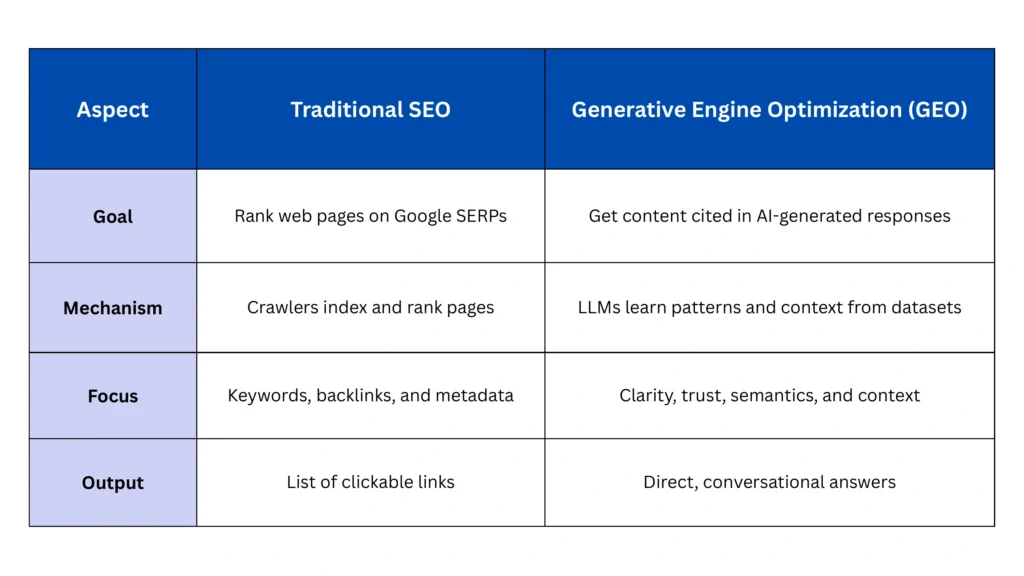
How GEO Differs From Traditional SEO
The fundamental difference between SEO and GEO lies in how information is processed and displayed.
Traditional SEO helps your page appear in the top results; GEO ensures your brand is embedded in the answers.
What Are Pre-Ingested Datasets?
Before an AI model can answer questions, it needs to learn from a pre-ingested dataset — massive collections of online content, including websites, reviews, forums, news articles, and even brand-owned materials.
If your brand’s content is well-structured, credible, and widely referenced across these sources, it increases the likelihood of being recognized and reused by generative engines.
For example, if a skincare brand publishes consistent product information across its website, e-commerce pages, and customer reviews, AI systems are more likely to trust and cite that brand when asked about “best skincare routines.”
Why GEO Matters More Than Ever
Recent studies show that 74% of problem-solving searches now return AI-generated summaries. Moreover, AI Overviews already appear in more than one in ten Google searches in the U.S.
This means that the traditional blue links are losing prominence. Visibility today means being part of the answer layer — the section of search where users directly read or hear AI-generated insights.
Ignoring GEO could mean your brand becomes invisible in this new layer of discovery. Embracing it, on the other hand, helps you maintain visibility, credibility, and trust.
Core Principles of Generative Engine Optimization
1. Structure and Clarity
AI models value clarity. Content with clean organization — headings, bullet points, FAQs, and summaries — helps models extract key information more efficiently.
Use tools like schema markup and structured data to indicate relationships between entities. For example, on a product page, clearly link product → category → reviews → brand name.
2. Trust and Reliability
AI systems favor content that demonstrates consistency and authority. Ensure factual alignment across your website, social profiles, and listings.
Include:
- Author credentials or organization information
- Cited data and verified references
- Clear, unbiased language
For example, a medical blog written by a certified nutritionist that cites clinical research is far more likely to be trusted and referenced by LLMs.
3. Contextual and Semantic Depth
GEO emphasizes meaning over keywords. Instead of repeating a phrase like “digital marketing services in Kerala”, use contextually rich language such as “SEO, content strategy, and online branding solutions for local businesses in Kerala.”
Include synonyms and related concepts — this improves your visibility in conversational queries like “how to grow a small business online.”
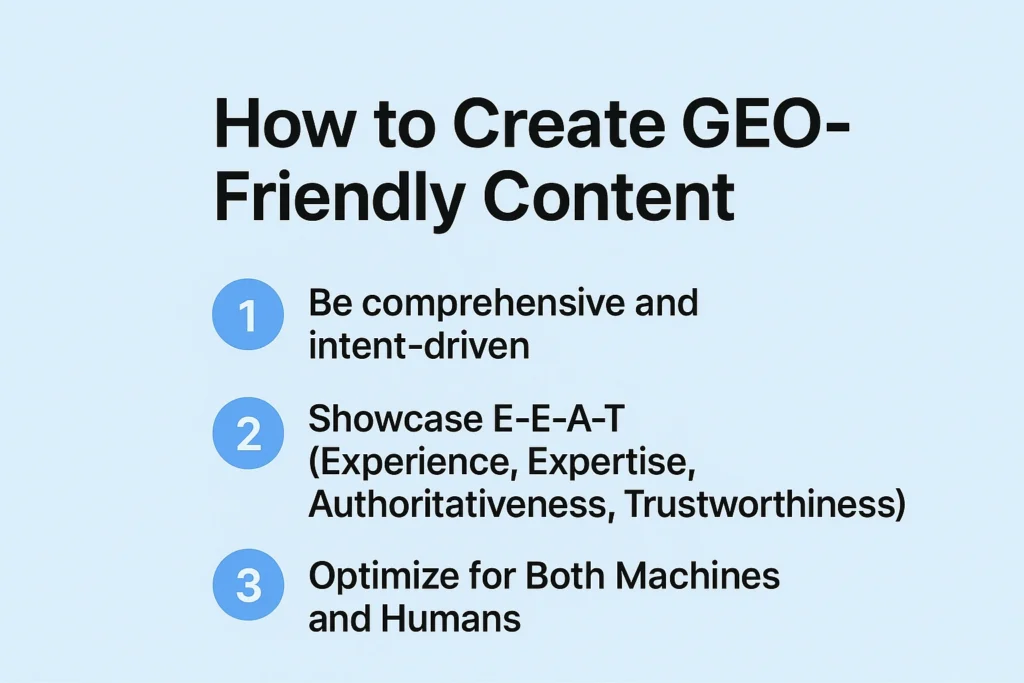
How to Create GEO-Friendly Content
1. Be Comprehensive and Intent-Driven
AI systems prefer answers that cover all aspects of a topic.
When writing, anticipate follow-up questions and related topics.
For instance, an article about “content ROI” should also explain:
- How to calculate content ROI
- Which KPIs are most effective
- Tools used to track performance
By addressing user intent, you make your content more likely to appear as a complete answer.
2. Showcase E-E-A-T (Experience, Expertise, Authoritativeness, Trustworthiness)
E-E-A-T is no longer optional — it’s foundational for GEO.
Highlight your experience through:
- Real-world case studies
- Testimonials or project results
- Author bios and industry recognition
If you’re writing about “SEO best practices,” reference your own campaigns or audits. AI models prefer citing content that demonstrates human experience and credibility.
3. Optimize for Both Machines and Humans
Readable, accessible content benefits both search engines and readers.
- Add FAQ sections for quick reference.
- Use alt text for visuals.
- Include summaries and key takeaways in long posts.
For example, a blog that ends with a concise takeaway like “Key metrics for measuring ROI include traffic growth, conversions, and cost efficiency” provides clear, structured data that AI systems can easily reuse.
How to Build a GEO-Ready Strategy
A GEO-friendly strategy blends SEO fundamentals with AI-aware content optimization.
- Audit your content: Check clarity, factual accuracy, and internal consistency.
- Enhance entity connections: Ensure your brand, products, and authors are clearly defined and interlinked.
- Use structured formats: Tables, comparisons, and schemas improve machine readability.
- Monitor citations: Track where your content appears in AI Overviews, ChatGPT, or Gemini results.
Update regularly: AI models value freshness and reliability — outdated data may reduce credibility.
The Future of GEO and Digital Visibility
Generative search will continue evolving as LLMs improve. Search behavior is shifting from typing keywords to asking natural questions. Voice search, AI snapshots, and personalized recommendations will further blur the line between search and conversation.
GEO ensures your brand remains visible across these new interfaces. By building trustworthy, structured, and contextually rich content today, you prepare your digital presence for tomorrow’s discovery ecosystem.
Generative Engine Optimization (GEO) represents a structural shift in how visibility works online.
SEO remains essential for discoverability, but GEO ensures that your brand is recognized, cited, and trusted in AI-generated responses.
For marketers and content creators, the challenge — and opportunity — lies in adapting faster than competitors. By focusing on structure, trust, and semantic depth, your brand can stand out not only in search results but in the evolving world of generative AI discovery.