


krizseo

What Is E-E-A-T?

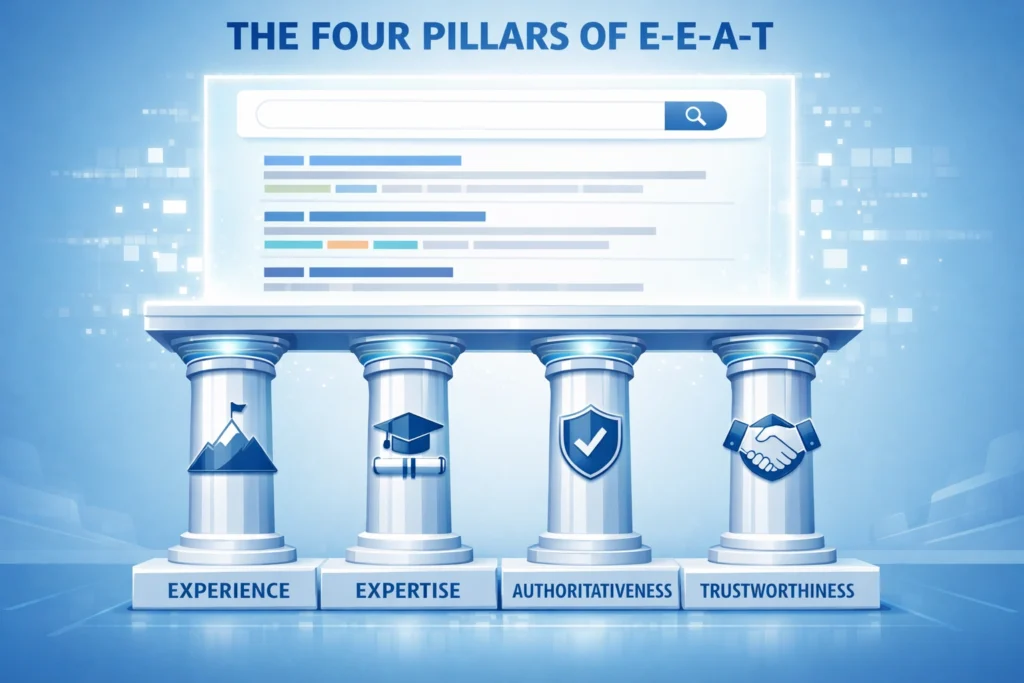
E-E-A-T ( Experience, Expertise, Authoritativeness, and Trustworthiness ) is a quality evaluation framework defined in the Google Search Quality Rater Guidelines and used by human quality raters to assess the quality of search results.

It’s important to understand this clearly:

E-E-A-T is not a direct ranking factor.
You cannot “optimize” a technical element called E-E-A-T inside your website.

Instead, it is a conceptual framework that guides how Google improves its ranking systems to surface helpful, reliable, people-first content.

Let’s break down each component.

Experience

Experience means having direct, first-hand involvement with a topic.

This includes:

  • Using a product before reviewing it


  • Visiting a place before writing about it


  • Running campaigns before teaching marketing


  • Solving real client problems before publishing case studies


In the AI era, this element is critical. AI can summarize knowledge, but it cannot replicate genuine lived experience. Real screenshots, case studies, original data, and practical insights signal strong experience.

Expertise

Expertise refers to the depth of knowledge, skill, and competence demonstrated in the content.

This can come from:

  • Formal qualifications


  • Professional background


  • Years of industry practice


  • Demonstrated mastery of a topic


The required level of expertise depends on the topic. For example, medical or financial content requires higher expertise than hobby-related content.

Expertise builds confidence. It tells both users and search systems that the content creator understands the subject beyond surface-level information.

Authoritativeness

Authoritativeness refers to recognition and reputation within a topic or industry.

Authority is demonstrated when:

  • Other reputable websites reference your content


  • You cover a topic comprehensively (topical authority)


  • You are known as a reliable source in your niche


  • Your brand is consistently associated with a specific subject


Authority is rarely built with one article. It is built through a structured content ecosystem and consistent value delivery.

Trustworthiness (The Most Important Pillar)

Trust is the core of E-E-A-T.

Experience, expertise, and authority all contribute to trust — but trust is the final outcome.

Trust is built through:

  • Accurate, fact-checked information


  • Transparent authorship


  • Clear contact details


  • Secure website (HTTPS)


  • Honest claims (no exaggerated promises)


  • Updated, reliable content


If a page is not trustworthy, the other three elements lose value. That’s why trust is considered the most important pillar of E-E-A-T.

Where Does E-E-A-T Come From?

E-E-A-T is defined in the Google Search Quality Rater Guidelines.

These guidelines are used by thousands of human quality raters worldwide to evaluate whether Google’s search results are helpful and reliable. Their feedback helps Google refine and improve its ranking systems.

However:

Raters do not directly influence rankings.
Their evaluations help Google adjust its algorithms over time.

Important Clarification

E-E-A-T ≠ Algorithmic metric

There is no visible “E-E-A-T score” inside Google.

E-E-A-T = A quality framework guiding algorithm improvements

If your content aligns with strong E-E-A-T principles, you align with what Google defines as high-quality search results — especially in competitive and sensitive niches.

In modern SEO, E-E-A-T is not about tricking the algorithm.
It means establishing trust across the digital ecosystem

E-A-T vs E-E-A-T – Why Google Added “Experience”

E-E-A-T in SEO

In December 2022, Google officially expanded E-A-T to E-E-A-T by adding an extra “E” for Experience. This update was documented in the Google Search Quality Rater Guidelines, reflecting how search quality evaluation evolved in response to major shifts in content creation.

Why Was “Experience” Added?

The biggest trigger was the rapid rise of AI-generated content.

With tools powered by large language models, anyone could produce content that sounds expert-level. This created a serious challenge:

  • Content may demonstrate knowledge


  • Content may appear well-structured


  • Content may cite accurate facts


  • But it may lack real-world experience


Google recognized that expertise alone is no longer enough.

The Importance of First-Hand Experience

Experience means the creator has:

  • Actually used the product


  • Personally performed the service


  • Conducted the experiment


  • Managed the campaign


  • Faced real-world challenges


This is something AI can simulate—but not genuinely replicate.

Example 1: Product Review

Weak (Expert-only):
Explains features based on manufacturer description.

Strong (Experience-driven):

  • Shows original photos


  • Mentions real pros and cons after usage


  • Describes durability over time


Compares based on actual testing

Example 2: SEO Case Study

Weak:
General explanation of ranking strategies.

Strong:

  • Shows before/after traffic screenshots


  • Mentions timeline (e.g., 4 months)


  • Explains what failed before success


  • Shares measurable results


That is experience-based credibility.

The Core Idea

AI can simulate expertise.
AI cannot replicate lived experience.

In the modern SEO landscape, this distinction matters more than ever.

Google’s algorithm improvements are increasingly aligned with signals that suggest:

  • Real-world involvement


  • Practical knowledge


  • Demonstrated outcomes


  • Personal accountability


Strategic Insight

Adding “Experience” shifted the focus from:

“Does this content sound correct?”
to
“Has this person actually done what they’re talking about?”

For SEO professionals, this means:

  • Add original insights


  • Share personal frameworks


  • Include real examples


  • Show proof of execution


  • Avoid purely theoretical content


Because in the E-E-A-T framework, lived experience strengthens authority — and authority builds trust.

Why E-E-A-T Became Central to Modern SEO

E-E-A-T is no longer a “nice-to-have” concept. It has become foundational to how modern search systems evaluate content quality — especially after repeated algorithm refinements by Google.

Let’s understand why.

1. Core Updates Reward It

Google’s Core Updates consistently reshape search visibility based on content quality signals.

A clear pattern has emerged:

  • Low E-E-A-T pages lose rankings


  • Thin, generic, AI-heavy content declines


  • Anonymous authors without credentials struggle


  • High-trust brands and proven experts gain visibility


Websites that:

  • Demonstrate real-world experience


  • Show topical depth


  • Have strong reputation signals


  • Build brand authority


…tend to recover or improve after updates.

In simple terms:

Core updates are quality recalibrations — and E-E-A-T is the evaluation lens.

2. Helpful Content System Is Built on It

Google’s Helpful Content System prioritizes:

People-first content > Search engine-first content

This means:

  • No writing just to rank


  • No keyword stuffing


  • No mass-produced low-value pages


  • No rewriting what already exists


Instead, Google looks for:

  • Genuine expertise


  • Clear intent satisfaction


  • Useful depth


  • Original insights


E-E-A-T acts as the foundation of “helpful content.”

If content lacks experience, authority, or trust — it is unlikely to be considered genuinely helpful.

3. Critical for YMYL Topics

E-E-A-T becomes even more important in YMYL (Your Money or Your Life) topics — areas where incorrect information can harm users.

These include:

  • Health


  • Finance


  • Law


  • News


  • Safety


For example:

  • A fitness blog can tolerate moderate E-E-A-T.


  • A heart surgery advice page cannot.


Higher risk = Higher E-E-A-T required.

If your content influences:

  • Financial decisions


  • Medical treatments


  • Legal actions


  • Public safety


Google demands:

  • Verified expertise


  • Strong author credibility


  • Institutional authority


  • High trust signals


Strategic Insight

Modern SEO is no longer about:

“Can I optimize this page?”

It is about:

“Should Google trust this page?”

E-E-A-T sits at the center of that decision.

That is why today:

  • Branding supports SEO


  • Topical authority strengthens E-E-A-T


  • Real case studies outperform theory


  • Reputation matters as much as optimization


In modern search, trust is the real ranking advantage.

E-E-A-T and Topical Authority – Why Depth Wins Over Keywords

E-E-A-T in SEO

In modern SEO, authoritativeness is topical authority in action.

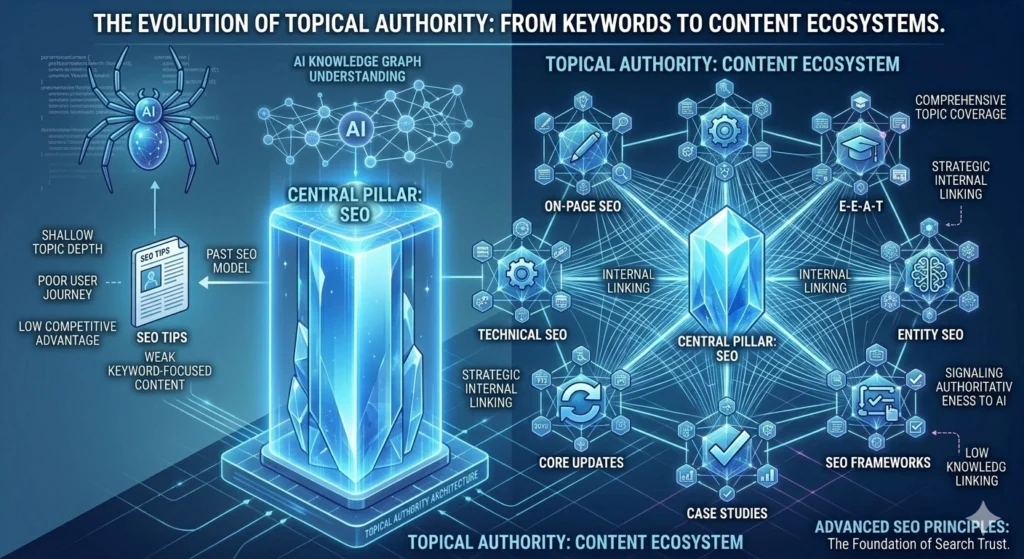
You cannot build authority by publishing one optimized article targeting a keyword. Authority is built when your website becomes a comprehensive resource on a subject.

Authoritativeness = Topical Authority Executed Properly

Topical authority is achieved through:

  • Topic clusters (pillar + supporting pages)
  • Semantic coverage (covering subtopics and related entities)
  • Internal linking strategy (clear content hierarchy)
  • Entity relationships (connecting concepts meaningfully)
  • Consistent depth across content

Instead of writing:

“SEO tips for beginners”

You build:

  • What is SEO?
  • On-page SEO
  • Technical SEO
  • E-E-A-T
  • Topical authority
  • Entity SEO
  • Core updates
  • Case studies
  • Common mistakes
  • Advanced frameworks

That is breadth + depth.

Breadth + Depth = Authority

  • Breadth → Cover the entire topic landscape
  • Depth → Go deep into each subtopic

Together, they signal to search systems that your site understands the subject holistically.

Key Concept

You cannot demonstrate authority with one article.
You demonstrate it with an ecosystem.

That ecosystem becomes your competitive moat.

Breaking Down the 4 Pillars of E-E-A-T

E-E-A-T in SEO

The E-E-A-T framework (defined in the Google Search Quality Rater Guidelines) evaluates quality using four interconnected pillars.

1. Experience (First-Hand Proof)

Experience means direct, real-world involvement.

This is shown by:

  • Real case studies


  • Testing data


  • Performance screenshots


  • Original photos


  • Personal insights


  • Process breakdowns


  • Lessons from failure


For example:
Instead of saying “SEO improves rankings,” show:

  • Traffic growth graph


  • Timeline (3–6 months)


  • Strategy implemented


  • Challenges faced


Why It Matters

Experience is the anti-AI advantage.

AI can summarize data.
AI cannot genuinely execute and document lived results.

Experience builds credibility faster than theory.

2. Expertise

Expertise refers to skill level and knowledge depth.

This can be illustrated by

  • Detailed author bio


  • Qualifications


  • Professional background


  • Certifications


  • Years of experience


  • Reviewed-by-expert notes (especially for YMYL topics)


  • Accurate citations and structured research


Important Note

The required level of expertise depends on search intent.

  • A recipe blog → Practical experience may be enough


  • Medical advice → Professional qualification required


  • Investment strategy → Financial credibility expected


Expertise must match the risk level of the topic.

3. Authoritativeness (Industry Recognition)

Authoritativeness is how others in your industry perceive you.

It is established through

  • Backlinks from trusted websites


  • Citations in trade journals


  • Brand searches


  • Public speaking events
  • Interviews


  • Strong content architecture


  • Personal brand building


Backlinks act as external trust signals.

If reputable sites reference you, your perceived authority increases.

But remember:

Authority is not just backlinks — it’s recognition + topical dominance.

4. Trustworthiness (The Core Pillar)

Trust forms the foundation of E-E-A-T.

Google emphasizes that trust is the most important pillar.

Trust is developed through

  • HTTPS security


  • Transparent contact information


  • Clear authorship


  • Accurate, up-to-date content


  • Regular updates


  • No deceptive ads


  • Clear disclaimers (when needed)


  • Honest positioning


Key Insight

Trust is the result of the other three combined:

  • Experience builds credibility


  • Expertise builds confidence


  • Authoritativeness builds reputation


  • Together → Trust


Without trust, the other signals lose power.

E-E-A-T Levels (Lowest to Highest)

Google evaluates content quality across a spectrum.

Lowest

  • Spam


  • Harmful misinformation


  • Deceptive content


  • Malicious intent


These pages deserve removal or de-ranking.

Low

  • Thin content


  • No real expertise


  • No authority


  • Irrelevant or misleading information


May exist — but rarely rank sustainably.

Medium

  • Helpful


  • Accurate


  • But average authority


  • Limited depth


  • Weak differentiation


This is where most websites sit.

High

  • Strong expertise


  • Demonstrated experience


  • Clear structure


  • Good brand presence


  • Consistent topical coverage


These sites perform well in competitive niches.

Highest

  • Original research


  • Investigative depth


  • Data-backed insights


  • Exceptional effort


  • Industry-level influence


These pages often become reference points.

The Core Purpose

Move from Medium → High → Highest over time.

E-E-A-T takes time to develop. It grows through

  • Consistent publishing


  • Demonstrated results


  • Strategic branding


  • Structured topical authority


  • Reputation growth


In modern SEO, ranking is not just about optimization.

It is about earning trust — systematically.

How Modern Search Understands E-E-A-T (Behind the Scenes)

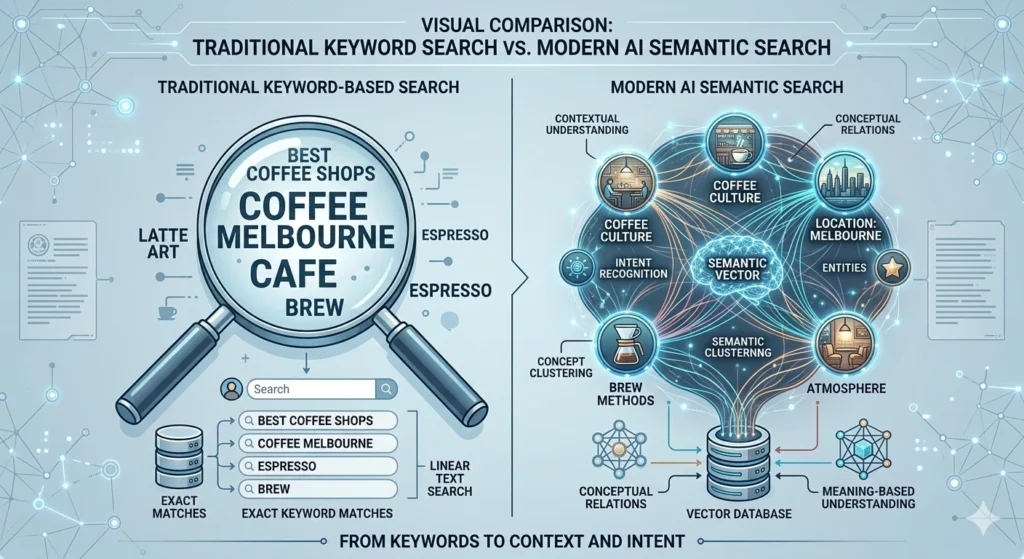
Modern search is no longer just about matching keywords. Today’s engines leverage advanced AI and machine learning to understand meaning, context, and relevance.

How It Works

Search engines analyze content using:

  • Semantic understanding – interpreting the intent behind queries, not just the literal words.

  • Entity recognition – identifying real-world people, places, concepts, and their relationships.

  • Contextual analysis – considering query context, user location, device, and search history.

Vector embeddings – converting text into multi-dimensional representations so that similar ideas are linked, even if words differ.

Key Idea

Vector search understands meaning, not just keywords.

This means content that is semantically rich, experience-driven, and authoritative performs better. Pages that clearly demonstrate E-E-A-T will naturally align with modern AI-driven search signals.

In other words: quality content with depth, experience, and context beats shallow keyword stuffing every time.

E-E-A-T in the Era of AI, AEO & GEO

As search evolves, AI-driven platforms like ChatGPT, Bard, and AI-powered SERPs are reshaping SEO. Demonstrating E-E-A-T is no longer optional—it’s central to AEO (Answer Engine Optimization) and GEO (Generative Entity Optimization).

AEO (Answer Engine Optimization)

Optimizing for AI-driven answers requires:

  • Clear, structured responses – organize content so AI can easily extract facts and insights.


  • Authority signals – demonstrate expertise, backlinks, and citations to trusted sources.


  • Schema markup – help AI and search engines understand content type, author, and relationships.


  • Concise, accurate answers – AI favors brevity and correctness over fluff.


  • Trusted sources – content from recognized authorities gets preference in AI-generated responses.


 In AEO, your content is not just for human readers—it’s designed to be understood, trusted, and cited by AI systems.

GEO (Generative Engine Optimization)

GEO focuses on making your brand and content referenceable by AI systems across the web. Unlike traditional SEO, clicks aren’t the only goal—being cited matters more.

Key strategies for GEO:

  • Brand authority matters – AI favors well-known, credible sources.

  • Strong digital footprint – consistent presence across multiple platforms, websites, and social profiles.

  • Mentions on trusted platforms – citations from authoritative sites reinforce credibility.

  • Future visibility – your content gets surfaced in AI-generated summaries, overviews, and zero-click results, even if users don’t click your page immediately.

GEO is about becoming a recognized reference in your niche—so AI, not just humans, trusts and cites your content.

RAG (Retrieval-Augmented Generation) & Why It Matters

RAG (Retrieval-Augmented Generation) is how AI combines retrieved information from trusted sources with generative answers. It’s crucial for brands aiming to appear in AI-powered summaries.

How it works:

  • AI first retrieves content from sources it considers authoritative and trustworthy.
  • Then, it augments answers with its generative capabilities, blending retrieved facts with natural language.

Why it matters for your site:

  • Strong authority → AI prefers citing your content.
  • Consistent topical depth → Rich, clustered content signals expertise and experience.
  • External trust signals → Backlinks, citations, and mentions increase your retrieval likelihood.

In the RAG era, being authoritative and credible isn’t optional—it’s how AI chooses your content as a source.

How to Build E-E-A-T Practically (Step-by-Step Strategy)

Building strong E-E-A-T isn’t theoretical—it’s actionable. The following framework can help you implement this effectively

1️⃣ Build Topical Clusters

  • Cover all relevant subtopics in your niche.

  • Create a content ecosystem that links related articles.

Use strategic internal linking to show relationships between content and demonstrate depth.

2️⃣ Showcase Real Experience

  • Publish case studies highlighting actual results.

  • Include data-backed insights and metrics.

Use real examples, screenshots, and original images to reinforce authenticity.

3️⃣ Strengthen Author Profiles

  • Include a detailed author bio with relevant qualifications.

  • Highlight professional credentials and real-world experience.

  • Add social proof (media mentions, awards, certifications).

  • Implement schema markup to help search engines clearly understand and recognize your expertise and authority.
  • Earn recognition by being featured in industry publications and trusted authority blogs..

  • Produce research-driven content that naturally attracts citations.

  • Collaborate with recognized authorities to enhance your site’s credibility.

  • Reference other trusted websites to demonstrate your research depth.

This shows users and search engines that your content is well-founded.

6️⃣ Maintain & Update Content Properly

  • Keep content fresh and relevant with real updates, not just cosmetic changes.

  • Add new insights or findings to improve depth and usefulness.

  • Ensure content continues to meet user needs and maintain trust over time

 Following these steps systematically will elevate your site from medium to high and eventually highest E-E-A-T, ensuring both human users and AI systems recognize your authority.

error: Content is protected !!
Scroll to Top