
krizseo

What Is a Knowledge Graph?

Data on its own has limited value unless it can be connected and understood in context. A knowledge graph organizes information by linking entities – such as people, places, organizations, products, and concepts – and the relationships between them. This connected structure helps search engines, AI systems, and businesses find more accurate insights, answer complex questions, and make better decisions. As AI-powered search and large language models continue to evolve, knowledge graphs have become a key technology for improving search, automation, and intelligent applications. This guide explains what a knowledge graph is, how it works, its core components, benefits, and real-world applications. 

What Is a Knowledge Graph?

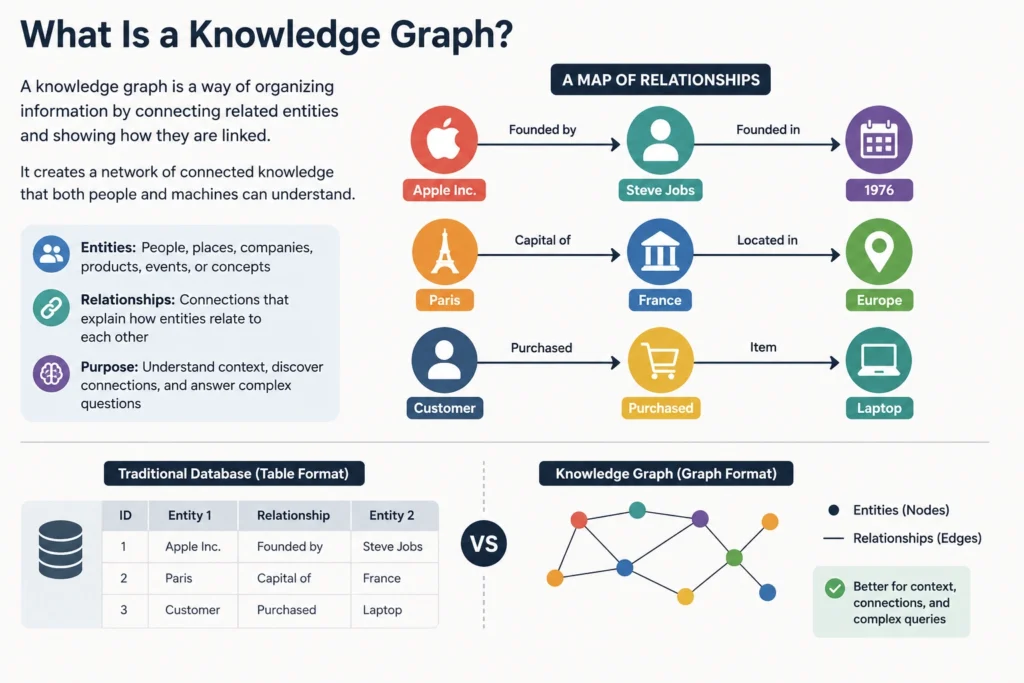
Knowledge graph diagram showing entities connected through relationships to help AI and search engines understand data, context, and real-world connections.

A knowledge graph is a way of organizing information by connecting related entities and showing how they are linked. Instead of storing data as separate records, it creates a network that both people and machines can understand.

The entities can be people, places, companies, products, events, or concepts, while the connections describe how they relate to one another.

For example:

  • Apple Inc.Founded bySteve Jobs
  • ParisCapital ofFrance
  • CustomerPurchasedLaptop

Rather than storing isolated facts, a knowledge graph connects them to reveal their relationships and meaning. This makes it easier to search for information, answer complex questions, and discover insights that would be difficult to find from disconnected data.

History and Evolution of Knowledge Graphs

The idea behind knowledge graphs began in the 1970s with semantic networks, which represented knowledge as connected concepts instead of isolated data. This research later influenced the Semantic Web, a vision for making web information understandable by machines through structured relationships.

Over the years, projects such as WordNet, GeoNames, DBpedia, and Freebase expanded the idea by organizing real-world entities and their relationships. In 2012, Google Knowledge Graph introduced the concept to millions of users through search results and Knowledge Panels. More recently, technologies like GraphRAG have combined knowledge graphs with large language models (LLMs) to improve AI reasoning and information retrieval.

Why Knowledge Graphs Matter

Most organizations store information across multiple systems, databases, and applications. As a result, valuable data often remains isolated, making it difficult to understand how different pieces of information are connected.

A knowledge graph solves this problem by linking related entities and their relationships into a single connected network. Instead of relying only on keywords, it understands the meaning and context behind information, helping search engines return more relevant results and AI systems generate more accurate responses.

For businesses, this connected view makes it easier to identify patterns, discover hidden relationships, and make faster decisions. It also provides AI models with reliable context, reducing the chances of inaccurate or misleading responses.

By connecting data instead of storing it in isolation, a knowledge graph makes information easier to search, understand, and use.

Core Components of a Knowledge Graph

Every knowledge graph is built using four main components: nodes, edges, labels, and properties. Together, they organize information and show how different entities are connected.

Nodes

Nodes represent the entities in a knowledge graph. An entity can be a person, company, product, place, event, or concept.

Examples:

  • Steve Jobs
  • Apple Inc.
  • Paris
  • iPhone 16
  • Eiffel Tower

Edges

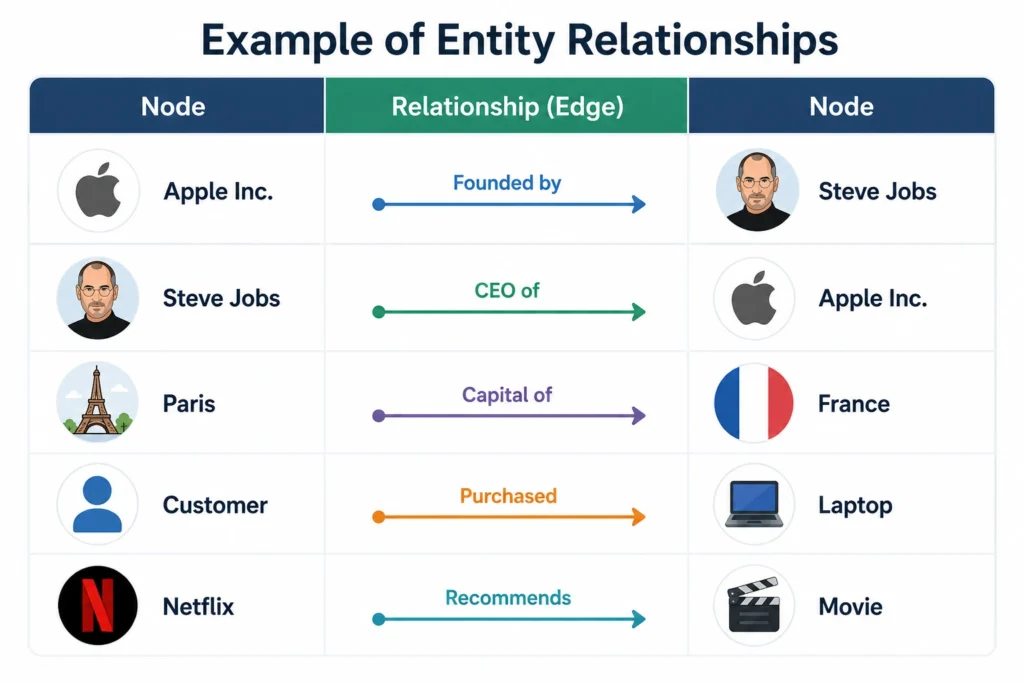
Edges represent the relationships between nodes. They define how one entity is connected to another.

Examples:

  • Founded by
  • Located in
  • Works for
  • Purchased
  • Manufactured by

For example:

Apple Inc.Founded bySteve Jobs

Labels

Labels categorize nodes and relationships, making them easier to identify and organize.

Node labels:

  • Person
  • Company
  • Product
  • City

Relationship labels:

  • Founded by
  • Located in
  • Purchased
  • Manufactured by

For example, Apple Inc. can have the label Company, while Founded by is the label for the relationship between Apple Inc. and Steve Jobs.

Properties

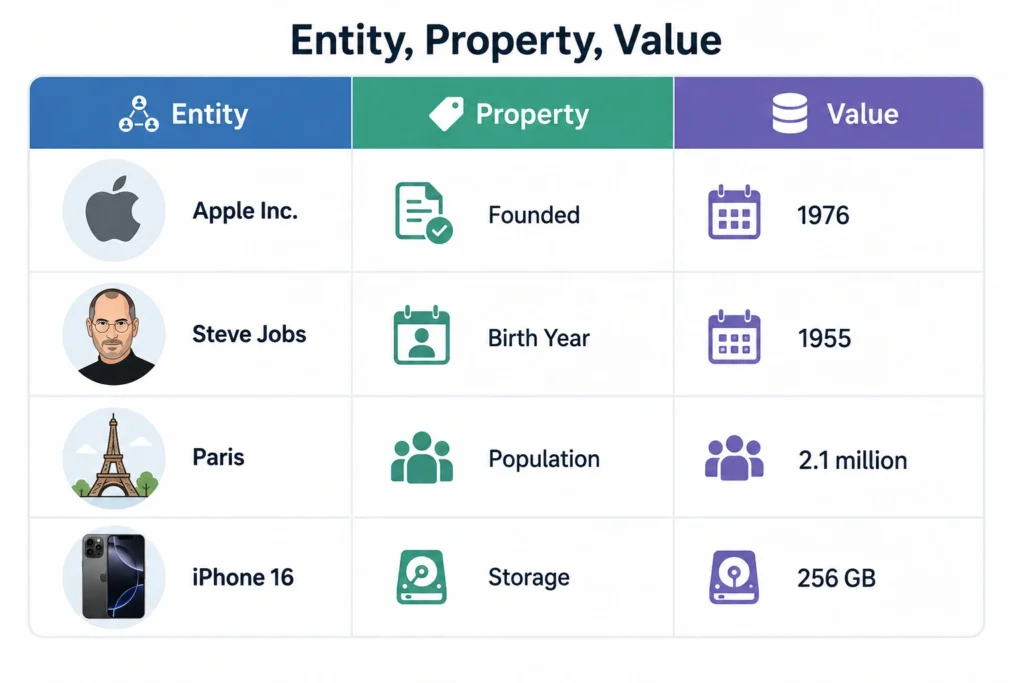
Properties store additional information about a node or relationship. They add context without creating new connections.

Knowledge graph diagram showing entities connected through relationships to help AI and search engines understand data, context, and real-world connections.

Example of Entity Relationships

Knowledge graph diagram showing entities connected through relationships to help AI and search engines understand data, context, and real-world connections.

These four components form the foundation of every knowledge graph. By connecting entities, relationships, and their attributes, they create a structured network that makes information easier to understand, search, and analyze.

Understanding RDF Triples

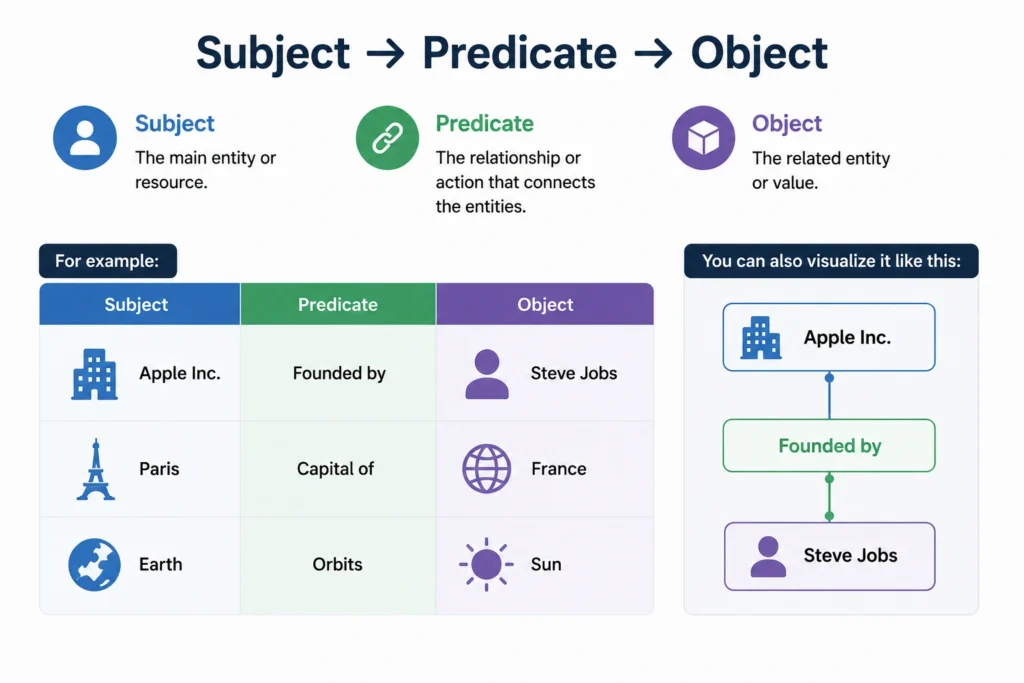
An RDF (Resource Description Framework) triple is the basic structure used to represent information in many knowledge graphs. Every fact is expressed using three connected parts:

Knowledge graph diagram showing entities connected through relationships to help AI and search engines understand data, context, and real-world connections.

Because every fact follows the same structure, RDF triples make it easier to connect, search, and exchange information across different systems. This consistent format forms the foundation of many knowledge graphs, allowing machines to understand relationships and retrieve information more accurately.

How a Knowledge Graph Works

Building a knowledge graph involves more than storing data. It connects entities, adds context, and organizes information so both people and machines can understand and use it effectively.

Step 1: Collect Data

The process begins by collecting data from multiple sources, such as databases, websites, APIs, business applications, and documents.

Step 2: Define a Schema

A schema defines the types of entities and relationships the knowledge graph can contain. It provides a consistent structure for organizing the data.

Step 3: Identify Entities

The system identifies important entities, such as people, companies, products, locations, or events.

Example:

  • Apple Inc.
  • Steve Jobs
  • iPhone 16

Step 4: Create Relationships

After identifying the entities, the knowledge graph connects them using meaningful relationships.

Example:

Apple Inc.Founded bySteve Jobs

Step 5: Apply Semantic Enrichment

Semantic enrichment identifies the meaning of entities and relationships, helping the system distinguish between similar terms and interpret data more accurately.

Example:

  • Apple → Company
  • Apple → Fruit

Step 6: Use NLP and Machine Learning

Natural Language Processing (NLP) extracts entities and relationships from unstructured text, while Machine Learning (ML) identifies new patterns and continuously improves the accuracy of the knowledge graph.

Step 7: Store the Data

The connected data is stored in a graph database, where entities and their relationships can be queried efficiently.

Step 8: Answer Queries

After the data is connected, applications can retrieve information by following relationships instead of searching isolated records.

For example, a knowledge graph can answer questions such as:

  • Who founded Apple Inc.?
  • Which products were developed by Apple?
  • What companies are related to Apple Inc.?

Because the information is connected, search engines, AI systems, and businesses can retrieve more accurate answers and discover relationships that would otherwise remain hidden.

Semantic Representation and Context

Knowledge graphs don’t just store words—they understand what those words mean based on context.

Why Does Context Matter?

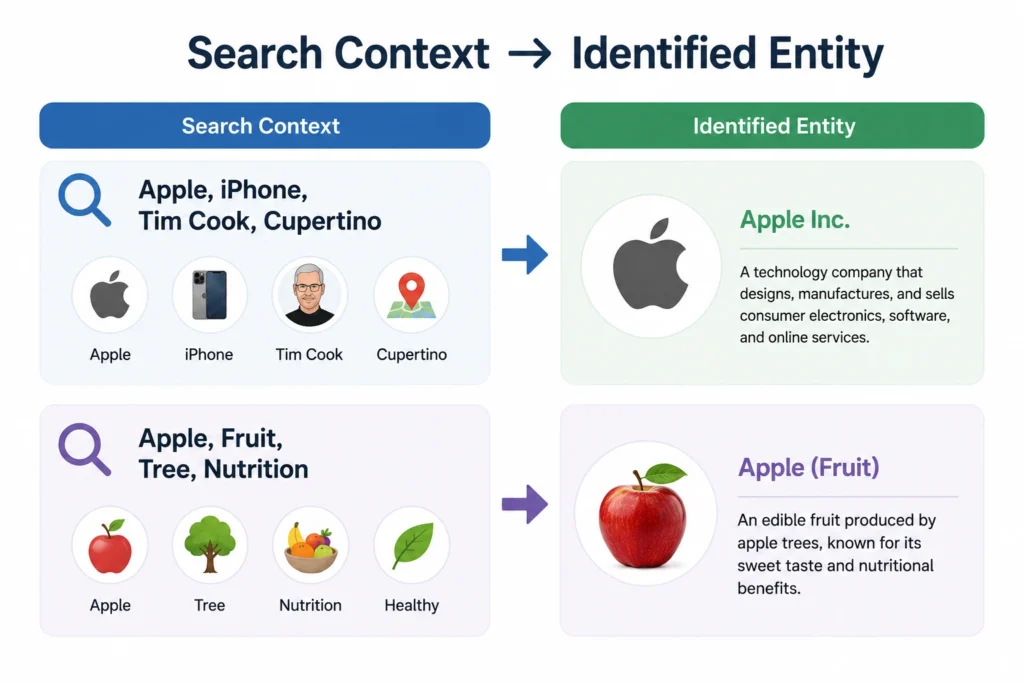
The same word can have multiple meanings. A keyword-based search may not always identify the intended meaning, but a knowledge graph uses surrounding relationships to determine the correct entity.

Example: Apple

Apple can refer to:

  • Apple (Fruit) – A type of fruit.
  • Apple Inc. – A technology company.

Without context, both meanings look the same. A knowledge graph uses related entities to identify the correct one.

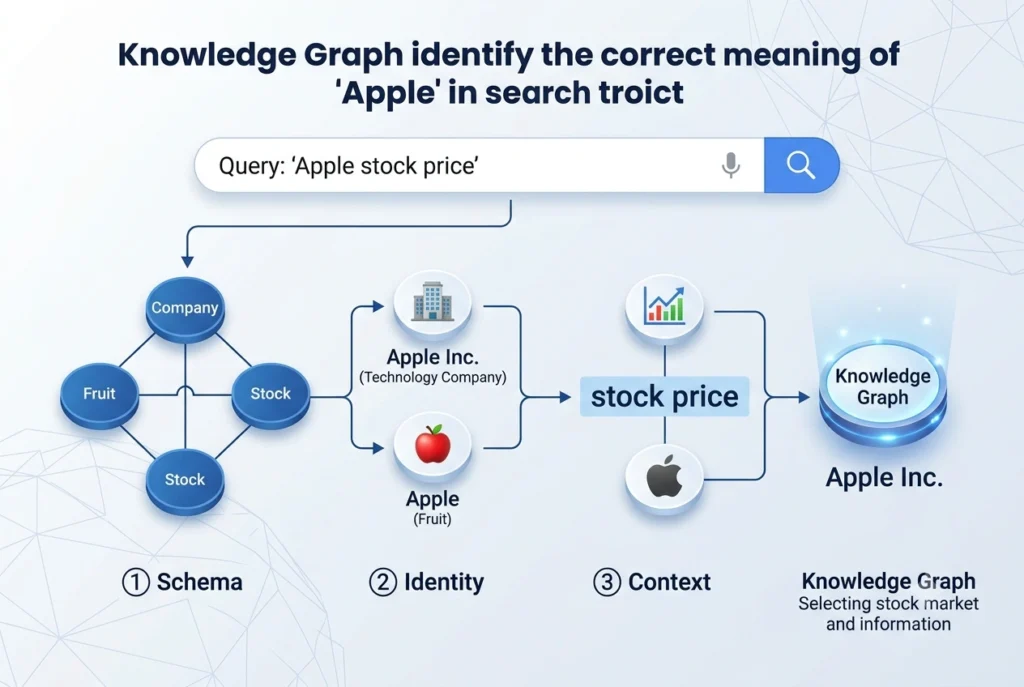
How a Knowledge Graph Uses Context

This process is called entity disambiguation—identifying the correct entity when multiple entities share the same name.

Knowledge graph diagram showing entities connected through relationships to help AI and search engines understand data, context, and real-world connections.

By analyzing relationships instead of individual words, a knowledge graph can identify the correct entity and deliver more relevant search results, accurate AI responses, and better recommendations.

Schemas, Identities, and Context

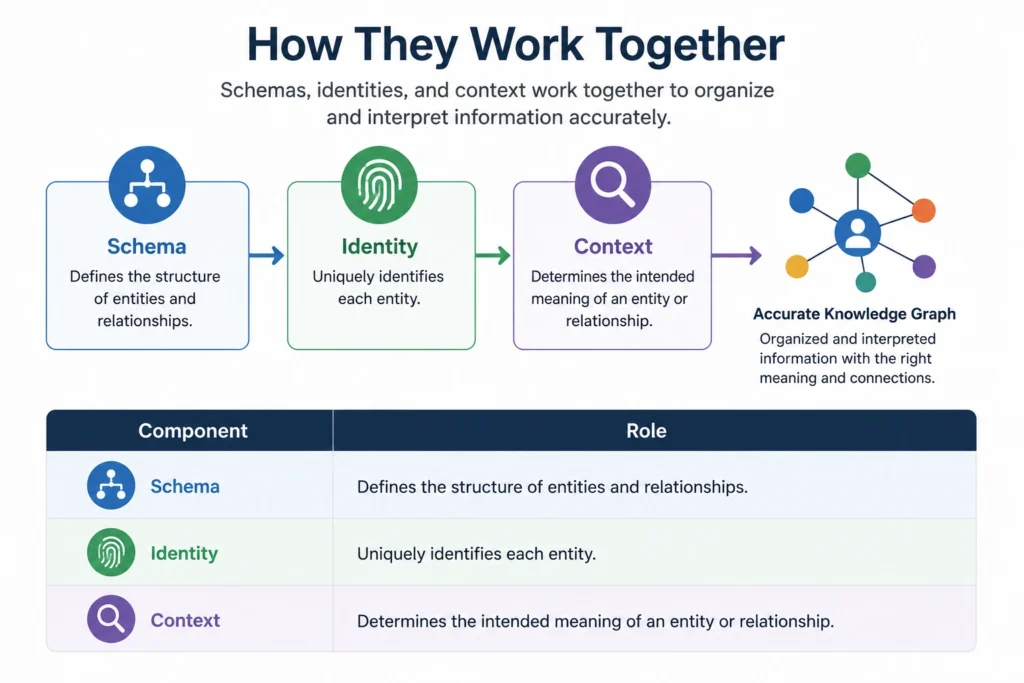
A knowledge graph uses schemas, identities, and context to organize data and understand the relationships between entities. Each has a specific role, and together they help transform raw data into meaningful information.

Knowledge graph diagram showing entities connected through relationships to help AI and search engines understand data, context, and real-world connections.

For example, when someone searches for “Apple stock price”, the schema recognizes Apple as a company, the identity matches it to Apple Inc., and the context (stock price) confirms that the user is referring to the technology company rather than the fruit.

By combining structure, unique identification, and context, a knowledge graph can interpret information more accurately and connect related data with confidence.

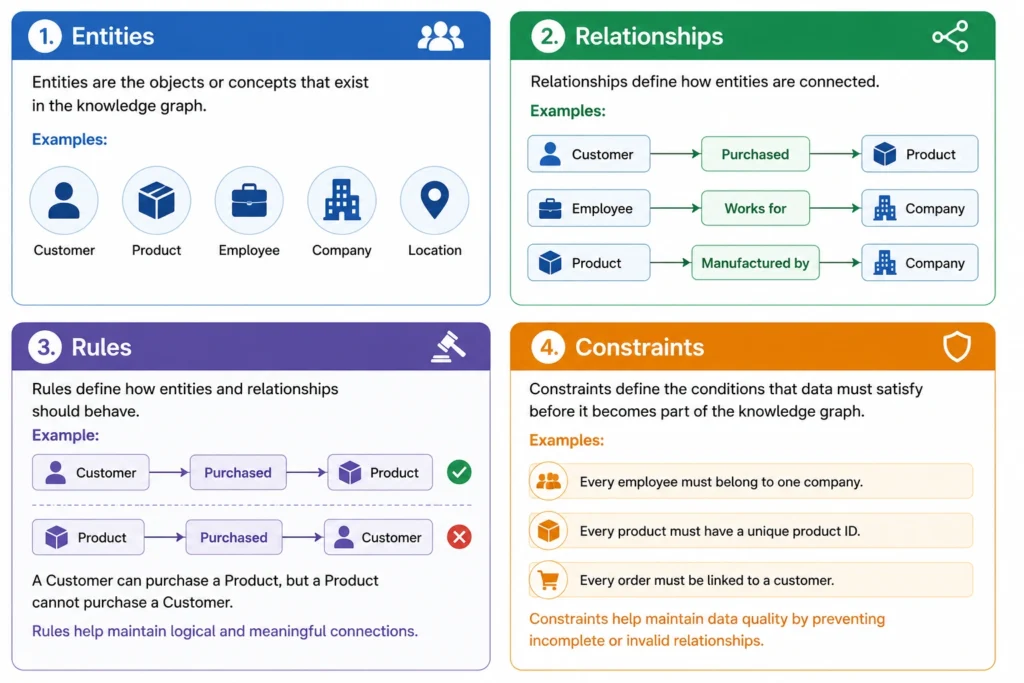
What Is an Ontology?

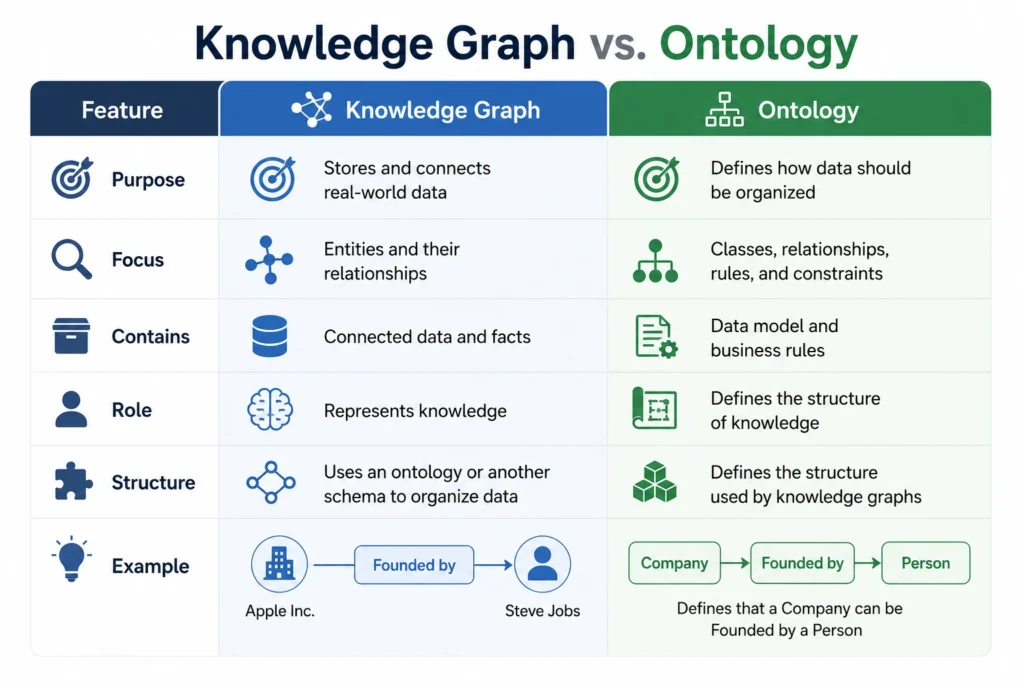
An ontology is a structured framework that defines how information is organized in a knowledge graph. Think of it as the rulebook for the knowledge graph. It defines what entities exist, how they are connected, and the rules that keep the data consistent.

Unlike a knowledge graph, which stores connected data, an ontology defines the structure that organizes and governs that data.

Knowledge graph diagram showing entities connected through relationships to help AI and search engines understand data, context, and real-world connections.

Why Is an Ontology Important?

Without an ontology, different systems might organize the same information in different ways. By defining a shared structure and common rules, an ontology keeps the knowledge graph accurate, consistent, and easier to maintain as new data is added.

Knowledge Graph vs. Ontology

Although knowledge graphs and ontologies are closely related, they serve different purposes. An ontology defines the structure and rules, while a knowledge graph uses that structure to store and connect real-world data.

Knowledge graph diagram showing entities connected through relationships to help AI and search engines understand data, context, and real-world connections.

Key Differences

  • A knowledge graph stores connected information about real-world entities and their relationships.
  • An ontology defines the structure, vocabulary, rules, and constraints that organize those entities.
  • A knowledge graph grows as new data is added, while the ontology provides the framework that keeps the data consistent.

Similarities

Both knowledge graphs and ontologies:

  • Represent entities and relationships.
  • Use semantic concepts to describe meaning.
  • Help machines understand connected data.
  • Support intelligent search, AI applications, and data integration.

How They Work Together

An ontology provides the foundation for a knowledge graph.

For example, an ontology may define:

  • Person
  • Company
  • Works for

The knowledge graph then stores actual data using those definitions:

Satya NadellaWorks forMicrosoft

As new data is added, the knowledge graph continues to grow while following the rules defined by the ontology.

error: Content is protected !!
Scroll to Top