
krizseo

What is RAG (Retrieval-Augmented Generation) ?

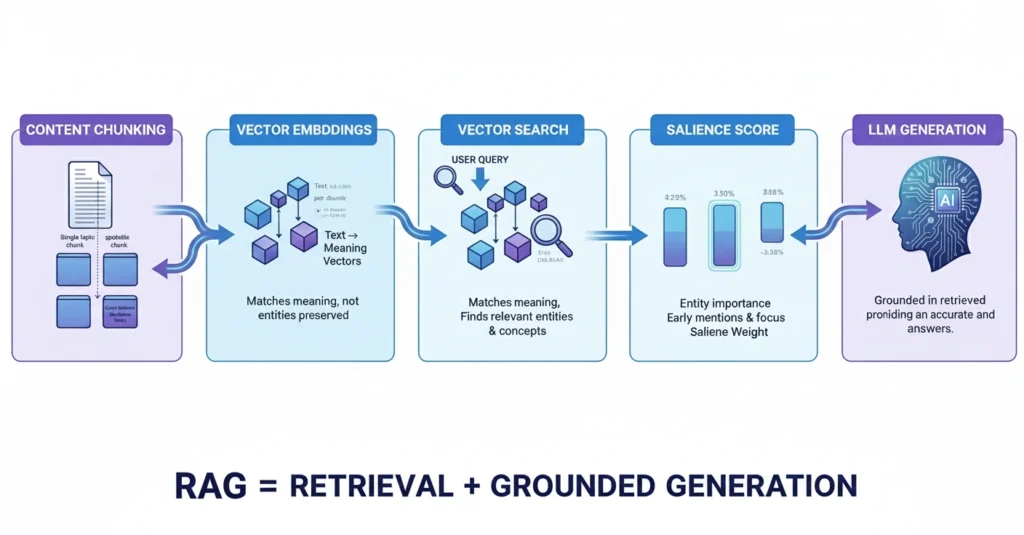
Retrieval-Augmented Generation (RAG) is an AI architecture that improves language model responses by retrieving relevant information from an external knowledge source before generating an answer. Instead of relying only on pre-trained data, RAG grounds responses in retrieved content, reducing hallucinations and improving accuracy.

From an SEO and content perspective, RAG changes how content is discovered and reused. AI systems no longer scan entire pages line by line. They retrieve specific content chunks based on semantic relevance, entity importance, and context.

In simple terms, RAG connects search, content, and generation into a single workflow.

How RAG Works ?

RAG works through a retrieval-first approach rather than generation-only logic. The system does not immediately generate an answer when a query is asked.

Instead, it follows these steps:

  1. The user query is converted into a vector embedding
  2. Relevant content chunks are retrieved using vector search
  3. Retrieved chunks are ranked based on semantic similarity and salience
  4. The language model generates a response grounded in the retrieved content

This process ensures that AI outputs are based on real, verifiable information, not assumptions.

For SEO professionals, this means content must be written in a way that is retrievable, not just readable.

Elements of RAG

Elements of RAG ( (Retrieval-Augmented Generation)

RAG is built on several core components. Each element plays a role in how content is selected and used.

1. Content Chunking

Chunking is the process of breaking content into small, self-contained sections. Each chunk focuses on one idea, entity, or question.

A good RAG chunk:

  • Covers a single topic
  • Is understandable without external context
  • Typically ranges between 80–250 words
  • Starts with a clear answer or definition

Chunks are the actual units AI systems retrieve, not full pages.

2. Vector Embeddings

Vector embeddings are numerical representations of text meaning. Each content chunk is converted into a vector that captures its semantic intent.

For example:

  • A chunk about “RAG in SEO”


  • A chunk about “RAG in healthcare”


Both may mention RAG, but their embeddings differ because the context and entities differ.

AI systems use embeddings to match user queries with the most semantically relevant content.

3. Vector Search

Vector search compares the query embedding with stored chunk embeddings. Instead of matching keywords, it measures meaning similarity.

This allows AI to retrieve:

  • Conceptually relevant content


  • Synonyms and related ideas


  • Entity-based explanations


Keyword stuffing has no advantage here. Clarity and intent matter more.

4. Salience Score

Salience score measures how important an entity or concept is within a chunk.

A chunk that:

  • Mentions the main entity early


  • Focuses primarily on that entity


  • Uses clear headings and definitions


will have higher salience than a chunk where the entity is mentioned casually.

Final ranking in RAG systems is often influenced by:

Vector similarity × Salience weight

This is why entity placement and structure matter.

5. Language Model Generation

Only after retrieval does the language model generate a response. The model uses retrieved chunks as grounding data, ensuring factual accuracy and relevance.

This is what separates RAG from traditional LLM responses.

RAG and GEO (Generative Engine Optimization)

RAG and GEO serve different but connected purposes.

  • RAG focuses on how AI systems retrieve and generate answers
  • GEO focuses on how content is optimized to appear in generative search results

From a GEO perspective, RAG determines which content gets picked by AI systems.

Well-optimized content:

  • Is chunkable
  • Is entity-focused
  • Has high salience
  • Is semantically clear

Poorly structured content may rank in traditional search but fail to appear in AI-generated answers.

In short:

RAG is the engine. GEO is the optimization strategy.

How to Optimize Content for RAG

Optimizing for RAG is not about keywords. It’s about retrievability.

1. Write Entity-First Content

Each section should clearly define:

  • What the topic is


  • Why it exists


  • How it works


Avoid vague introductions. Start with definitions.

2. Use Clear Chunk Structure

  • One main idea per H2 or H3


  • Short paragraphs inside each chunk


  • Avoid mixing multiple concepts in one section


Think of every section as a standalone answer unit.

3. Place Important Information Early

AI assigns higher importance to content placed at the beginning of a chunk.
Definitions, entities, and explanations should appear in the first paragraph.

4. Reduce Generic Language

Avoid sentences that sound reusable across topics.
Replace them with:

  • Explanations


  • Cause-effect logic


  • Real-world usage descriptions


This improves both EEAT and salience.

5. Strengthen EEAT Signals

  • Add an author profile with real experience


  • Use factual explanations


  • Reference practical use cases


  • Maintain consistency across related topics


AI systems prefer content that demonstrates expert understanding, not marketing tone.

Final Takeaway

Retrieval-Augmented Generation changes how content is selected, ranked, and reused by AI systems. Pages are no longer consumed as a whole. Instead, individual chunks compete for retrieval.

If your content is:

  • Entity-clear


  • Chunk-structured


  • Semantically strong


  • Experience-driven


It becomes eligible for both RAG retrieval and GEO visibility.

FAQs

1. What is RAG in simple terms?

Retrieval-Augmented Generation (RAG) is an AI approach where a language model retrieves relevant information from an external data source before generating a response. This ensures answers are grounded in real content instead of relying only on pre-trained knowledge.

2. How is RAG different from a normal AI model?

A normal AI model generates responses only from its training data. RAG first retrieves relevant content using vector search and then generates an answer based on that retrieved data, reducing hallucinations and improving accuracy.

3. Why is RAG important for AI search and SEO?

RAG is important because AI systems no longer read entire webpages. They retrieve specific content chunks based on semantic relevance and entity importance. For SEO, this means content must be structured, chunked, and entity-focused to be retrievable.

4. What role do vector embeddings play in RAG?

Vector embeddings convert text into numerical representations of meaning. In RAG systems, both queries and content chunks are embedded into vectors, allowing AI to match them based on semantic similarity rather than keywords.

5. What is vector search in RAG?

Vector search is the process of comparing a query embedding with stored content embeddings to find the most semantically relevant matches. It enables AI to retrieve conceptually related content even when exact keywords are not used.

6. What is a salience score in RAG?

A salience score measures how important a specific entity or concept is within a content chunk. Chunks where the main entity is clearly defined, placed early, and consistently discussed receive higher salience and are more likely to be retrieved.

7. How does chunking improve RAG performance?

Chunking improves RAG performance by breaking content into small, self-contained sections that focus on one idea or entity. Each chunk can be embedded, indexed, and retrieved independently, making AI responses more precise.

8. What is the ideal chunk size for RAG content?

The ideal chunk size for RAG is typically between 80 and 250 words. This size provides enough context for meaning while remaining focused and retrievable.

9. What is the relationship between RAG and GEO?

Retrieval-Augmented Generation (RAG) determines how AI systems retrieve and generate responses using external content, while Generative Engine Optimization (GEO) focuses on optimizing content so it is selected and cited by those AI systems. RAG controls content selection and grounding, whereas GEO improves content visibility and retrievability within RAG-based and generative search environments.

10. Does traditional keyword SEO work for RAG?

Traditional keyword-based SEO alone does not work effectively for RAG systems. Retrieval-Augmented Generation relies on semantic meaning, entity relevance, and structured content rather than exact keyword matching. While keywords still help provide context, RAG systems prioritize how well a content chunk explains an entity or concept over how often a keyword appears. To perform well in RAG-based retrieval, content must be entity-focused, clearly structured, and semantically complete, not keyword-stuffed.
error: Content is protected !!
Scroll to Top