
SEO is no longer keyword-first.
Search engines don’t rank pages simply because they contain the right phrases. Today, algorithms evaluate depth, relationships between concepts, contextual signals, and real expertise.
Modern search is built on semantic understanding. Powered by systems like the Google Knowledge Graph and advancements after Google Hummingbird, Google now understands topics, entities, and intent — not just keywords.
This shift has completely changed how authority is built online.
Topical authority is how you win in semantic and AI-driven search.
It’s how you signal to Google that your site doesn’t just mention a subject — it deeply understands it. It’s how you position your content to appear in AI summaries, zero-click results, and advanced search features.
If traditional SEO was about optimizing pages, modern SEO is about owning topics. And topical authority is the foundation.
What Is Topical Authority (Beyond the Basic Definition)
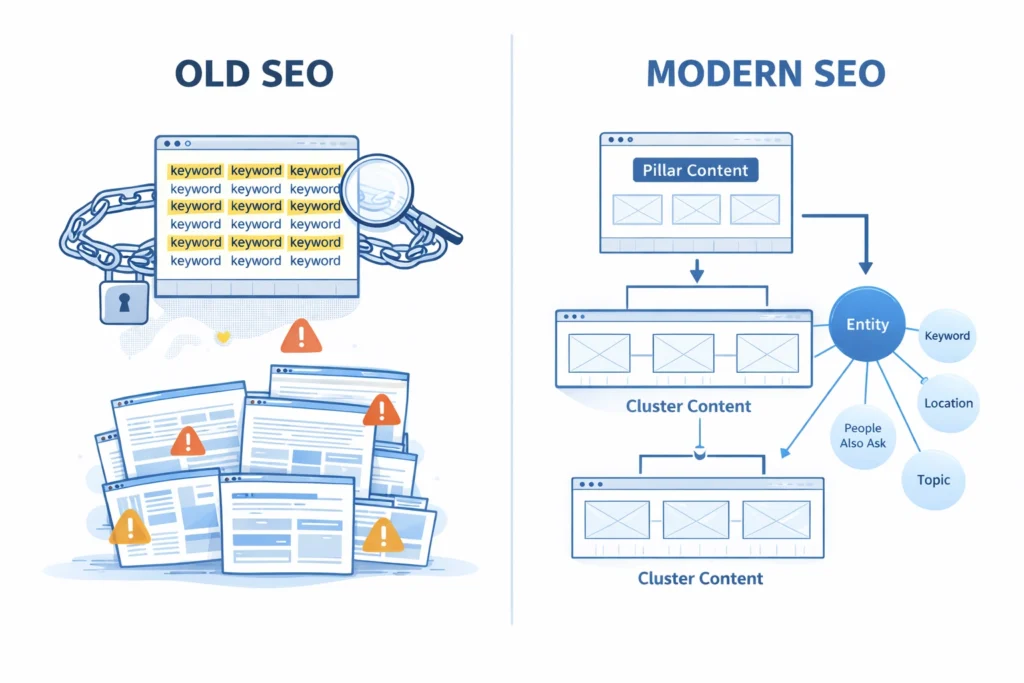
Topical authority is the level of trust a search engine assigns to your website within a clearly defined subject area.
It is not built from a single article.
It is built across multiple interlinked pages that collectively demonstrate depth, structure, and expertise.
When your website consistently covers a topic from multiple angles — definitions, strategies, tools, comparisons, case studies, and advanced insights — search engines begin to recognize your domain as a reliable source within that niche.
Topical authority is earned through:
- Depth – Comprehensive explanations, not surface-level content
- Consistency – Repeated coverage within the same subject cluster
- Semantic coverage – Inclusion of related entities, subtopics, and contextual signals
Most importantly, topical authority is not a visible metric.
You won’t find a “Topical Authority Score” inside analytics tools. It is a ranking outcome — the result of strong content architecture, semantic alignment, and structured internal linking.
Topical Authority vs Domain Authority vs Page-Level Relevance
These three concepts are often confused, but they operate differently.
1. Topical Authority
- Authority within a specific subject
- Built through content clusters and semantic depth
- Topic-focused, not site-wide
A website can dominate SEO as a niche topic while having limited authority in other areas.
2. Domain Authority (Link-Driven Strength)
Domain authority reflects overall site strength, largely influenced by backlinks, technical health, and site age.
It is commonly associated with metrics from tools like Moz, but search engines themselves evaluate broader link-based signals.
A strong domain may rank faster — but without topical depth, rankings are rarely sustainable.
3. Page-Level Relevance
Page-level relevance refers to how well a single page matches a specific query.
This includes:
- Keyword targeting
- On-page optimization
- Content clarity
A page can be highly relevant to one query without the site having strong topical authority.
The Core Difference
- Domain authority = overall power
- Page relevance = query match
- Topical authority = subject ownership
Modern SEO rewards subject ownership.
You don’t win by optimizing isolated pages.
You win by building interconnected knowledge ecosystems around your core topics.
The Evolution of Topical Authority in Google’s Algorithms

Topical authority did not appear overnight. It evolved as search engines shifted from keyword-matching systems to semantic understanding engines.
To understand why topical authority matters today, we need to understand how Google’s algorithms evolved.
From Keyword Matching to Semantic Understanding
Pre-Hummingbird Era (Keyword Dependency)
Before 2013, search was heavily keyword-dependent.
Google primarily ranked pages based on:
- Exact keyword usage
- Keyword density
- Backlinks
- Domain age
- Anchor text
If a page repeated the right phrase enough times and had strong backlinks, it could rank — even if it lacked depth or contextual clarity.
Search engines struggled to understand:
- The meaning behind queries
- Variations of phrasing
- Relationships between concepts
SEO was largely mechanical.
Introduction of Semantic Analysis
As search behavior evolved — especially with mobile and voice search — Google needed to interpret meaning, not just match strings of text.
Semantic analysis allowed Google to:
- Understand synonyms
- Interpret context
- Recognize related concepts
- Evaluate overall topical relevance
This shift laid the foundation for topical authority. Instead of rewarding isolated keyword optimization, Google began favoring sites that demonstrated subject-level understanding.
The Impact of Google Hummingbird (2013)
The release of Hummingbird marked a major turning point.
It wasn’t just a small update — it was a core rewrite of how search queries were processed.
Conversational Search
Hummingbird improved Google’s ability to interpret natural language queries, especially longer, conversational searches.
Instead of matching individual words, Google began understanding full questions.
For example:
- “Best way to improve SEO rankings”
- “How can I increase organic traffic without backlinks?”
These queries required contextual understanding.
Context Over Keywords
After Hummingbird, ranking became less about exact-match keywords and more about:
- Topic coverage
- Content clarity
- Relevance to intent
Pages that thoroughly explained a subject started outperforming thin, keyword-stuffed content.
Query Intent Interpretation
Google began identifying user intent behind queries:
- Informational
- Transactional
- Navigational
This was critical in shaping modern SEO. Content needed to align with intent — not just include keywords.
Topical authority became a competitive advantage because intent coverage requires structured topic depth.
Entity-Based Search & Knowledge Graph
Another major transformation came with the introduction of the Google Knowledge Graph.
Instead of indexing just pages and keywords, Google started indexing entities.
Entity Recognition
An entity can be:
- A person
- A brand
- A product
- A concept
- A location
Google began identifying these entities within content and linking them to its internal knowledge systems.
Relationship Mapping
Search engines now map how entities relate to each other.
For example:
- SEO connects to backlinks
- Backlinks connect to anchor text
- Anchor text connects to link signals
When your content mirrors real-world entity relationships, it strengthens semantic clarity.
Topic Graph Construction
Google essentially builds topic graphs — structured networks that connect related entities and subtopics.
Websites that demonstrate strong, consistent coverage across a topic cluster become authoritative nodes in that graph.
This is where topical authority lives.
Modern SEO is no longer about ranking a page.
It’s about becoming a trusted node within Google’s topic network.
How Google Actually Evaluates Topical Authority

Google does not have a specific or publicly visible “topical authority” score.Instead, authority is inferred from multiple structural, semantic, and trust-based signals working together.
Search engines analyze how deeply you cover a subject, how your pages connect, how entities relate, and whether your site demonstrates real expertise.
Here’s how it’s evaluated in practice.
1. Breadth + Depth of Coverage
Topical authority requires both range and substance.
Breadth means you cover all major subtopics within a core theme.
If your main topic is SEO, breadth includes technical SEO, on-page SEO, link building, content strategy, entity SEO, local SEO, analytics, and more.
Depth means you don’t stop at definitions. You:
- Answer primary questions clearly
- Address secondary and follow-up questions
- Provide frameworks, examples, and practical insights
- Explain why concepts matter
Surface-level content does not build authority. Comprehensive coverage does.
Google evaluates whether your site consistently answers related queries within a topic cluster — not just one isolated keyword.
2. Internal Linking & Crawl Patterns
Internal structure plays a critical role.
Search engines analyze:
- How your pages link to each other
- Which pages receive the most internal references
- Whether a clear hierarchy exists
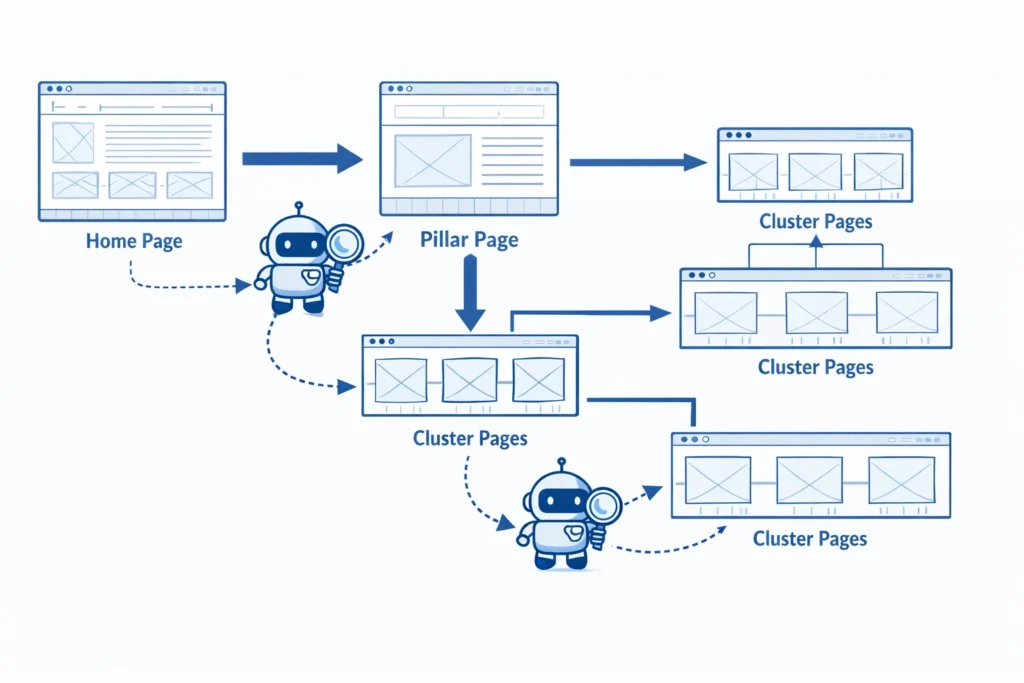
A strong topical model follows:
Pillar → Cluster → Reciprocal linking
- A pillar page targets the broad core topic
- Cluster pages dive into specific subtopics
- Cluster pages link back to the pillar
- The pillar links out to all supporting content
This creates:
- Clear topical hierarchy
- Reinforced semantic importance
- Strong crawl pathways
When crawlers repeatedly encounter structured interconnections around a topic, it signals thematic consistency and authority.
Random blog posts without structural linking do not create this signal.
3. Contextual Entity Relationships
Modern search relies heavily on entities.
Google does not just look for keywords — it identifies:
- Related tools
- Relevant brands
- Industry concepts
- Recognized experts
- Metrics and terminology
When related entities consistently appear together across authoritative sources, this creates co-occurrence signals.
For example, a strong SEO article may naturally reference:
- Search intent
- Backlinks
- Crawling
- Indexing
- Content clusters
- Analytics platforms
When your content aligns with real-world entity relationships within your industry, it strengthens semantic credibility.
This is called entity alignment with industry context.
The more accurately your content reflects how topics are connected in the real world, the stronger your topical authority becomes.
4. User Intent Coverage (Do, Know, Go)
Google evaluates how well your content aligns with search intent.
Intent generally falls into three categories:
Informational (Know)
Users want to understand something.
Example: “What is topical authority?”
Transactional (Do)
Users want to take action.
Example: “Best SEO tools for building topical authority”
Navigational (Go)
Searchers are trying to reach a particular website, brand, or specific online destination.
A strong topical authority site does not only publish informational content. It covers multiple intent layers within the same cluster.
For example:
- Definitions
- Step-by-step guides
- Tool comparisons
- Case studies
- Service-related content
Multi-intent coverage signals deeper expertise and stronger topic ownership.
5. Trust & E-E-A-T Signals
Topical authority is amplified by trust.
Google’s quality systems evaluate Experience, Expertise, Authoritativeness, and Trust (E-E-A-T) through indirect signals such as:
Author credibility
- Clear bylines
- Demonstrated experience
- Professional positioning
Citations
- Referencing credible external sources
- Linking to research or authoritative platforms
Content freshness
- Updated statistics
- Current screenshots
- Revised strategies reflecting algorithm changes
Transparency pages
- About page
- Contact page
- Privacy policy
- Clear brand identity
Consistency of expertise
- Repeated coverage within a focused niche
- No random topic jumping
Trust strengthens authority.
Without credibility and consistency, semantic structure alone will not sustain rankings.
The Role of Entities in Building Topical Authority
Topical authority is deeply connected to entities.
Modern search engines no longer index just pages and keywords. They index entities and the relationships between them. This is why entity optimization has become foundational to semantic SEO.
If keywords are the language of search, entities are the structure behind it.
What Are Entities in SEO?
An entity is a clearly defined, distinguishable concept that search engines can recognize and categorize.
In SEO, entities typically include:
- People (industry experts, founders, authors)
- Products (software, platforms, tools)
- Concepts (search intent, crawling, indexing)
- Organizations (brands, companies, institutions)
- Metrics (CTR, bounce rate, domain authority)
- Tools (analytics platforms, SEO software, crawlers)
For example, when discussing SEO strategy, referencing systems like Google Analytics or organizations like Google adds entity-level clarity.
Search engines recognize these as defined nodes in their database — not just words in text.
Entities make content machine-understandable.
Knowledge Graph & Entity Indexing
The introduction of the Google Knowledge Graph changed how search works.
Instead of ranking documents purely by text signals, Google now:
- Identifies entities within content
- Connects them to its knowledge base
- Maps relationships between them
- Evaluates how accurately they are used
For example:
- SEO relates to search engines
- Search engines relate to indexing
- Indexing relates to crawling
- Crawling relates to bots
These connections form a semantic web of relationships.
When your content includes relevant, correctly connected entities, it strengthens semantic clarity.
When it omits important entities, it may appear incomplete.
Entity inclusion signals subject familiarity.
Co-Occurrence & Semantic Reinforcement
Co-occurrence refers to how frequently certain terms and entities appear together across authoritative sources.
For example, in high-quality SEO content, you will consistently see:
- Backlinks
- Anchor text
- Crawl budget
- Internal linking
- Ranking factors
These terms reinforce each other semantically.
Search engines analyze patterns across the web. If authoritative pages consistently mention certain entities together, that cluster becomes contextually validated.
When your content mirrors these natural industry associations, it gains semantic reinforcement.
This creates:
- Frequently associated term signals
- Industry-standard terminology alignment
- Contextual completeness
In contrast, content that lacks expected entities may be perceived as shallow or off-topic.
Creating an Entity Map for Your Niche
Before writing, advanced SEO strategy involves building an entity map.
This means identifying all major and secondary entities related to your topic — and understanding how they connect.
You can extract entities from:
- SERPs
- Analyze top-ranking pages
- Identify recurring concepts and terminology
- People Also Ask
- Discover related questions
- Extract supporting concepts
- AI Overviews
- Identify summarized entity clusters
- Note how topics are grouped
- Top-Ranking Pages
- Map headings
- Extract repeated entities
- Identify structural similarities
After extraction, build topic relationships before writing.
Ask:
- Which entities are core?
- Which are supporting?
- How do they logically connect?
- Which deserve standalone cluster pages?
This structured entity mapping transforms content from keyword-optimized to knowledge-structured.
Content Clusters – The Structural Backbone of Topical Authority
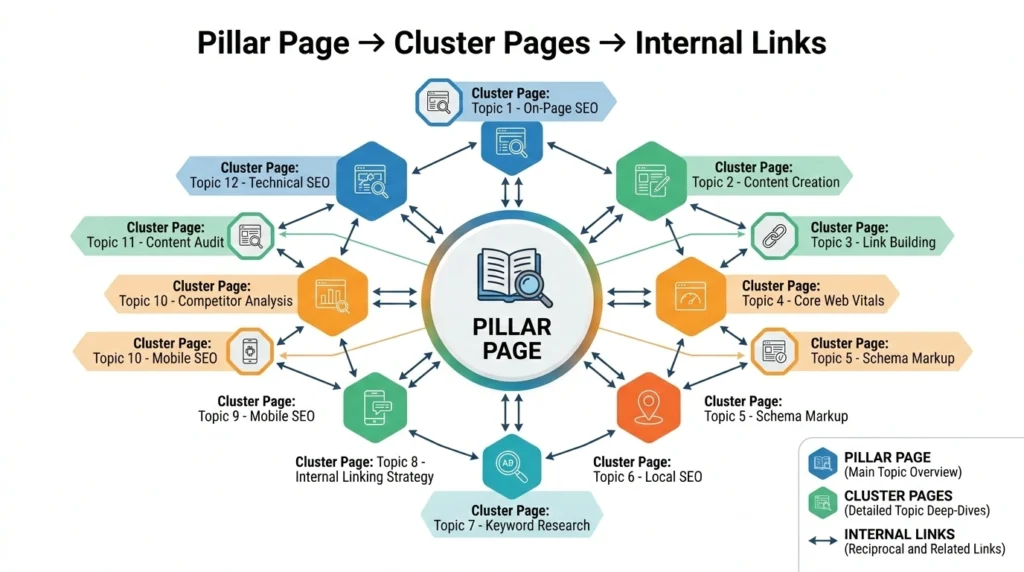
If entities are the building blocks of semantic SEO, content clusters are the architecture.
Search engines reward structured knowledge. A scattered collection of blog posts does not create authority. A strategically connected content ecosystem does.
Content clusters provide that structure.
Pillar Page Model
The pillar page is the central authority document for a broad topic.
It:
- Provides a comprehensive overview
- Covers all major subtopics at a high level
- Links to detailed supporting articles
- Targets high-volume, competitive core keywords
For example, a pillar page on “Topical Authority” would introduce:
- Semantic SEO
- Entity optimization
- Content clusters
- Internal linking
- E-E-A-T signals
But it would not deeply explain each section — that’s the role of cluster pages.
The pillar acts as the topical hub.
Search engines interpret this as a primary thematic node within your site.
Supporting Cluster Pages
Cluster pages dive deep into specific subtopics.
They:
- Target lower-competition keywords
- Focus on long-tail and question-based queries
- Provide in-depth explanations
- Link back to the pillar page
Examples of cluster topics under “Topical Authority” could include:
- How to build an entity map
- Internal linking best practices
- Semantic SEO vs traditional SEO
- Avoiding keyword cannibalization
Each cluster page should solve a specific intent clearly and completely.
When multiple cluster pages interlink with the pillar, they reinforce topical relevance through structure.
This creates semantic density around the core topic.
Pillar-First vs Cluster-First Strategy
There are two main approaches when building clusters.
Pillar-First Strategy
You create the comprehensive pillar page first, then build supporting cluster pages around it.
Best for:
- New websites
- Clearly defined niches
- Planned SEO roadmaps
This approach creates immediate structural clarity and sets a strong topical foundation.
Cluster-First Strategy
You build multiple in-depth cluster pages first, then consolidate and connect them with a comprehensive pillar later.
Best for:
- Existing blogs with scattered content
- Sites undergoing SEO restructuring
- Large content libraries
This method is often used during content audits and consolidation projects.
Scalability Considerations
For long-term growth:
- Maintain consistent internal linking rules
- Avoid publishing random, unrelated topics
- Expand clusters vertically before moving horizontally
- Document your topical map
Scalable authority requires intentional planning — not reactive publishing.
Avoiding Keyword Cannibalization
One of the biggest risks in cluster models is keyword cannibalization.
This happens when multiple pages compete for the same query.
To prevent it:
- Assign a Unique Angle per Page
Each article must target a distinct intent or subtopic. - Consolidate Overlapping Content
If two pages serve the same purpose, merge them and redirect the weaker one. - Maintain Internal Anchor Clarity
Use consistent, descriptive anchor text when linking between pages.
Avoid linking multiple pages using the exact same primary keyword anchor.
Clear differentiation ensures that:
- Each page has a defined ranking purpose
- Authority is consolidated instead of diluted
- Search engines understand your topical hierarchy
Content clusters are not just an SEO tactic.
They are the structural backbone of topical authority — transforming individual articles into a connected knowledge ecosystem.

Krishnendu (Kriz) is a freelance SEO expert, digital marketing strategist, and SEO trainer with 3+ years of hands-on experience in the SEO and digital marketing industry. I currently serve as a Trainer and Head of Department (HOD) at Clear My Course Digital Marketing Institute, where I mentor aspiring marketers with a strong focus on practical, real-world SEO.
I’ve successfully handled 50+ SEO projects across multiple industries, working with startups, local businesses, and service-based brands to improve organic visibility, search rankings, and lead generation. My experience includes both agency-level execution and independent consulting, allowing me to build scalable and sustainable SEO strategies rather than short-term fixes.
As an SEO trainer and HOD, I’ve trained 100+ students, guiding them through foundational SEO concepts as well as advanced frameworks like semantic SEO, entity relationships, AI search behavior, and content optimization for long-term authority. My training approach is rooted in live projects, audits, and real ranking scenarios, not just theory.
Through my blog, YouTube channel, and professional work, I share practical SEO insights, strategy-driven content, and up-to-date perspectives on evolving search algorithms, AI-powered search, entity SEO, E-E-A-T, and GEO—helping business owners, marketers, and students make informed decisions and build long-term digital credibility.